
In the second of two short articles on recent developments in the law of nuisance, this piece looks at key takeaways in both negligence and nuisance in a case brought against a local authority, based on its public law duties.
Sintes v. Tower Hamlets LBC concerns a case which leapfrogged from a deputy district judge to the Court of Appeal. As Lord Leggatt JSC said in the first case of this series, “a classic way of developing the common law is to derive a new general rule from existing cases”, and, up to a point, this is what the Court of Appeal has done in its judgment, at least in relation to the question whether liability can exist for an omission (explaining East Suffolk Rivers Catchment Board v. Kent [1941] AC 74 (1940), when a landowner failed to recover after the drainage board negligently extended the time taken to arrest flood damage from 14 to 164 days).
The Court of Appeal also raised, but did not fully answer, the contentious issue of what amounts to the adoption or continuing of a nuisance (under the measured duty of care under Sedleigh-Denfield v. O’Callaghan [1940] AC 880), in particular how a defendant can be said to have “adopted” a nuisance on its land just by the passing of time.
As to the facts of the rather unpromising case which was in front of the DDJ, they were these.
After alighting from a bus, Mrs Sintes tripped over a number of metal poles protruding from a trolley over ground designated for pedestrians. The poles were intended for use on adjacent market pitches. This apparently lay open a claim in public nuisance, but the highway authority was Transport for London. Tower Hamlets was the licensing authority for the market traders under the London Local Authorities Act 1990. A claim was also made in negligence based on the alleged duties arising out of the 1990 Act.
Negligence
In allowing the appeal by the local authority, Stuart-Smith LJ went laboriously through the powers and duties of Tower Hamlets. For the purpose of property and environmental lawyers, what will be of interest (and might otherwise have been easily missed), is the adoption, by the Court of Appeal, of the relevant general principles which apply to liability where there has been an alleged omission to act, especially in the case of the actions of public bodies. These have been extracted from two cases concerning actions against the police and are worth stating.
The two cases are Michael v. Chief Constable of South Wales Police [2015] AC 1732 (HL) and Tindall v. Chief Constable of Thames [2024] UKSC 33, [2025] AC 1046.
As to Tindall, the Court of Appeal in Sintes quoted the very first paragraph, which it is worth setting out verbatim below (whilst repeating only the key points).
“It has long been recognised that the tort of negligence draws a fundamental distinction between acts and omissions…, between making matters worse (or harming) and failing to confer a benefit (or to protect from harm). As a general rule, a person has no common law duty to protect another person from harm or to take care to do so: liability can generally arise only if a person acts in a way which makes another worse off as a result. … It is now firmly established … that the liability of public authorities in the tort of negligence to pay compensation is governed by the same principles that apply to private individuals. … That means that to recover such compensation a claimant generally needs to show that the public authority did not just fail to protect the claimant from harm but actually caused harm to the claimant.”
Repeating what was said by the Supreme Court from the earlier case of Michael: “The fundamental reason … is that the common law does not generally impose liability for pure omissions. It is one thing to require a person who embarks on action which may harm others to exercise care. It is another matter to hold a person liable in damages for failing to prevent harm caused by someone else.”
The general rule, then, is that A has no duty of care to protect B from harm, the exceptions being those circumstances in which (i) A has assumed a responsibility to protect B from a specific danger, (ii) A has done something which prevents another from protecting B, (iii) A has a special level of control over the source of danger, or (iv) A’s status creates an obligation to protect B from that danger. This summary has now been adopted by the Court of Appeal, albeit that it is derived from an academic article Negligence Liability for Omissions and the Police [2016] CLJ 128.
East Suffolk Rivers Catchment Board v. Kent
This case going back to 1940 will be familiar to both property and environmental lawyers in the context of the extent of a duty of care and omissions to act.
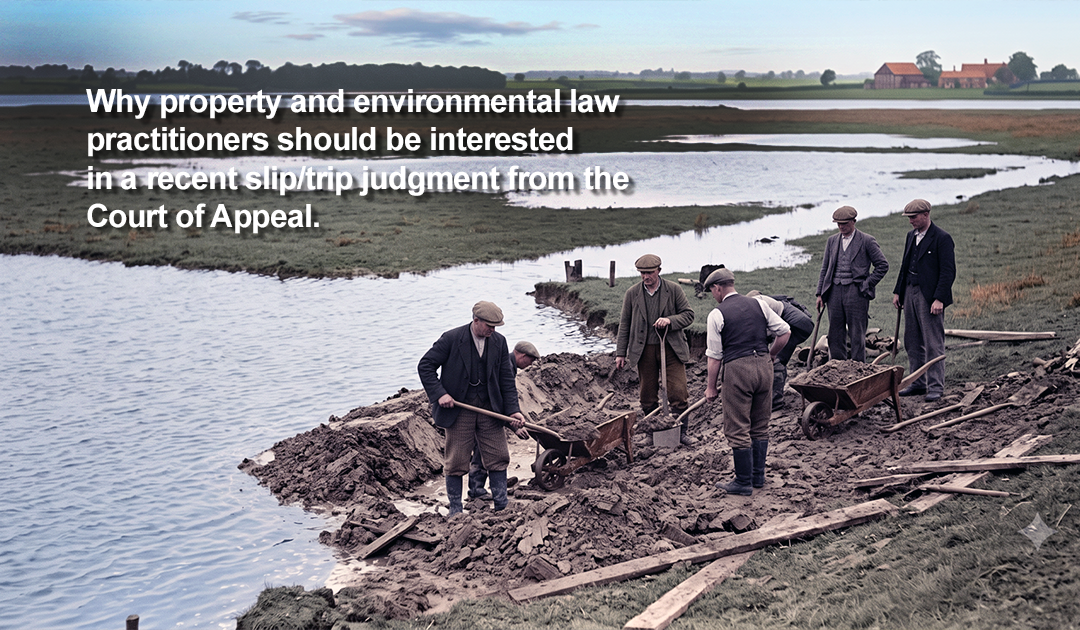
After catastrophic fluvial flooding in 1936, the river Deben burst its banks in many places in Suffolk, causing tidal water to cover marsh pastures.
The local board was able to exercise its powers to fix about thirty of these breaches, but in the case of the claimant’s land, the methods employed and the staff were so inefficient that what could have been fixed in 14 days took 164 days.
East Suffolk Rivers was decided on the basis that the defendant board did not cause the extra damage. The cause of the damage was the operation of nature.
In Tindall, the Supreme Court cited East Suffolk Rivers in order to illustrate the difference between making matters worse (when the finding of a duty of care is generally found to be straightforward) and failing to confer a benefit. It is only if the carrying out of an activity makes matters worse off, as compared with the outcome if the activity had not been undertaken at all, that liability will arise.
In order to make this assessment, it is convenient (if difficult) to establish a ‘baseline’ (see Sintes and Tindall). Thus, in East Suffolk Rivers, the ‘baseline’ was what would have happened if the defendant had done nothing at all, i.e. if it had not embarked on the activity in question. The answer to this was that the flooding which took place was caused by the operation of nature. The failure to close it “merely” allowed the damage to continue until the broken bank was repaired.
The assumption of responsibility
As an exception to the general rule that nobody (including a public authority) has a duty to protect another person from harm or to take care to do so, the Court of Appeal in Sintes has borrowed again from Tindall and from additional cases concerning the emergency services.
Whilst it is possible for an assumption of responsibility to arise out of the performance of statutory functions (N v. Poole BC [2020] AC 780), an assumption of responsibility “involves the idea that a person may, by words or conduct, expressly or impliedly promise (or undertake or give an assurance) to take care to protect another person from harm” (Tindall cited at para.75 of Sintes). There was “no meaningful sense” in which it could be said that Tower Hamlets had assumed responsibility for the safety of Mrs Sintes as she walked along the highway in the market area.
Nuisance
The question whether there can be liability for a dangerous hazard which a defendant has not created was resolved in Sedleigh-Denfield v. O’Callaghan [1940] AC 880.
This was the case in which the trespassing local authority had installed a pipe to ensure that rainwater did not cascade into the block of flats which it owned. Unfortunately no grating was installed at the mouth of the pipe to stop it from flooding. The Mill Hill Fathers took steps regularly to clear it out, but when they did not do so one year, the result was the flooding of a house belonging to someone else at the bottom of the hill.
The House of Lords decided that there is a measured duty of care (a species of negligence) which gives rise to liability in the event that a party has “adopted” or “continued” a nuisance. The Mill Hill Fathers had done both.
It remains very uncertain as to what is meant by these expressions. In Sintes, the claimant relied on LE Jones v. Portsmouth City Council [2003] 1 WLR 427, but this only decides that, whether or not a party is an occupier or non-occupier, that party will be responsible for adopting a dangerous item if it had “sufficient control over the hazard which constitutes the nuisance for it to be reasonable to make him liable for the foreseeable consequences of his failure to exercise that control so as to remove the hazard” (para.11). Such control can arise, for instance, from the terms of a contract or lease. Indeed, this was the test which, in essence, was applied in the Rylands case of Rubis Bahamas Ltd v. , discussed in the first of these linked articles.
The Court of Appeal did not consider it necessary to embark on a review of the law relating to the or continuance of a nuisance. However, it pointed out that liability in respect of the measured duty of care exists only where two prerequisites to a finding of adoption or continuation can be proved, knowledge and opportunity (para.113). Neither could be demonstrated by Mrs Sintes.
To this extent, the Court of Appeal decision in this trip/slip case provides for a new vocabulary to be applied to the measured duty of care in nuisance (knowledge and opportunity), as well as summarising and identifying the relevant tests when examining whether all that is being alleged is an omission to act, especially in the case of a public authority.
GORDON WIGNALL
wiglaw.co.uk
info@wiglaw.co.uk
Just checkingt – adaption seems to fit but not a commo word – should this be adoption/adaptation?