
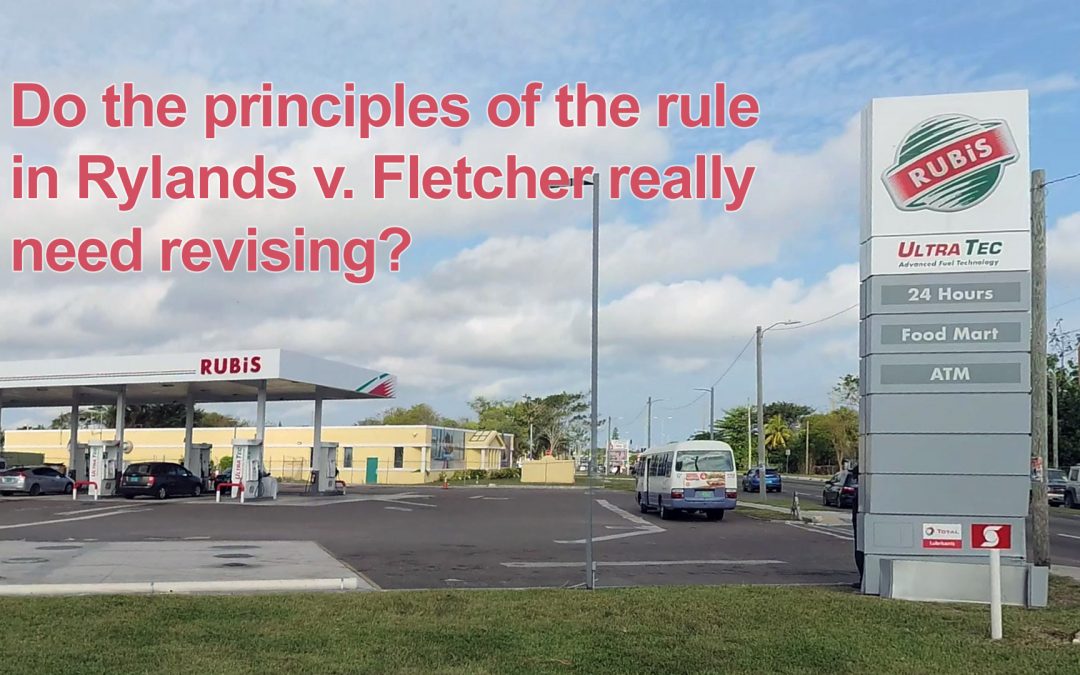
The Court of Appeal which heard Nicholas v. Thomas in February is still deliberating the consequences of Fearn v. Tate Gallery Trustees on the law of nuisance, but, pending this important decision, there are two cases of some interest which are worth considering. This article examines the first of them, Rubis Bahamas Ltd. v. Russell [2026] 2 WLR 896.
In Rubis Bahamas Ltd., the Privy Council considered the principles relevant to the rule in Rylands v. Fletcher. Although the single judgment professed to emphasise the differences between the rule and the law of private nuisance, in reality, the Privy Council has re-affirmed that the relevant principles are strikingly similar.
The only material contribution to the case law is clarity that if the polluting item which has caused damage is commonplace in the area, then that can still mean that it is an extraordinary item to be kept at the defendant’s peril. Just because there are many service stations in The Bahamas does not mean that the escape of petroleum from an underground drum is not an extraordinary use of land.
By way of a recap, Rylands v. Fletcher itself was the case in which the contractors of the developer of a reservoir, in exercising insufficient care during the course of its construction, part-filled the reservoir with water, which broke into the horizontal shafts of a mine and then travelled vertically, flooding it. The Court decided that if a party collects anything likely to do damage if it escapes, then that party is responsible for the consequences of the escape.
The conclusions of the recent Privy Council case should come as no surprise, since, as the Board itself acknowledged, weighty speeches in the House of Lords in two earlier cases explained that the rule in Rylands is best considered a species of nuisance.
First, in Cambridge Water v. Eastern Counties Leather [1994] 2 AC 664, Lord Goff recognised that, whilst Rylands could be seen as a development of the laws relevant to strict liability (including animal trespass), it should be treated today “essentially as an extension of the law of nuisance to isolated escapes from land”.
Cambridge Water was about small accidental discharges of liquid used in the defendant’s tanning process which travelled over many months down through an aquifer into the claimant’s water treatment plant.
Secondly, in Transco plc v. Stockport MBC [2003] UKHL 61, [2004] 2 AC 1, Lord Bingham described Rylands v. Fletcher as a “sub-species of nuisance”. Transco was about the escape of water from a pipe leading into a block of flats which caused subsidence in a mound of soil, fracturing the gas pipe which the mound supported.
In Rubis Bahamas Ltd, the claimant sued the party which had owned a service station, the underground tanks of which had leaked. The defendant was reported to have acquired the service station from Texaco in November 2012, being the same month in which it went on to lease the premises to a third party, Fiorente Management and Investments Ltd. Fiorente had leased all of the tanks and pipes and was responsible for routine maintenance, and was obliged to purchase fuel from Rubis. The claimant had not sued Fiorente.
Examining the more detailed terms of the lease, the Board decided that Rubis met the threshold Rylands criteria, in that it could be treated as responsible for introducing and keeping the escaped fuel at the service station. This was because the lease showed that Rubis required the premises to be used by Fiorente as a service station and because it required the fuel purchased from Rubis to be stored and dispensed there. Moreover, the equipment used on the premises for storage and for dispensing could only be maintained by Rubis.
The Privy Council’s short point arising out of the examination of the lease was that a party does not need to be a landowner to be held liable in Rylands. The material question is who was responsible for the accumulation. There is no difference here with the application of the law of nuisance. The party liable in private nuisance is the party which brought about the state of affairs giving rise to the nuisance, as well as the party which is in a position to abate a nuisance which arises on its land. It was irrelevant in this case that Fiorente might also be liable.
The Board then turned to the question as to what amounts to a ‘non-natural’ or ‘extraordinary’ use of land, leading to the conclusion discussed above. If an activity is exceptionally dangerous then it is no defence that it is commonplace.
The Board got to this result after a lengthy discussion about reciprocity and the rule of “give and take; live and let live”, the suggestion being that if there are many dangerous tanks of fuel, then parties need to accept the risks as a principle of “mutual sufferance”.
The judgment of the Board in Rubis Bahamas Ltd. was given by Lord Leggatt JSC, who gave the majority judgment in Fearn. In Fearn, the Court spent some time discussing competing parties’ freedom to use land as they wish as well as question of the balance to be struck between the interests of competing parties. As can be seen, these topics were again in issue in Rubis Bahamas Ltd.
It is perhaps unfortunate that the judgment of Laws LJ in Arscott v. The Coal Authority [2005] Env LR 6 is not more well known (especially paras.25-31) and was cited neither in Rubis Bahamas Ltd. nor in Fearn. Laws LJ pointed out that a constellation of themes is in play in respect of the law of nuisance. These include a bias (effectively “a conclusive rule”) against non-natural user where that involved the escape of something noxious on to a neighbour’s land. Where there is physical damage, there is little point in assessing a ‘balance’. Physical damage to property does not readily engage a principle of mutual sufferance.
The judgment of the Board in Rubis Bahamas Ltd is, in reality, a contemporary iteration of the principles of private nuisance applied to the rule in Rylands, one which Lord Goff and Lord Bingham would have understood. Moreover, the relevance of questions of reciprocity and of balance have been compendiously considered in previous cases involving physical damage to land, such as in Arscott. Unlike cases of intangible interference (such as noise or smells), competing land use issues are hardly relevant.
The judgment went on to raise one peripheral topic which, in reality, has no place in the contemporary application of the rule in Rylands. Lord Leggatt JSC commented that “The Board would wish to reserve its opinion on whether compensation for [personal injuries] could be in principle be recovered” (para.75). It is well established that in private nuisance damages for personal injury are not recoverable (Malone v. Laskey [1907] 2 K.B. 141).
Just because there are historic differences between the origins of private nuisance and of the rule in Rylands, this is not a reason, given the way in which the rule is now treated (as a sub-species of private nuisance), to revisit the possibility that Rylands v. Fletcher offers a means for obtaining damages for personal injury.
Gordon Wignall
info@wiglaw.co.uk