
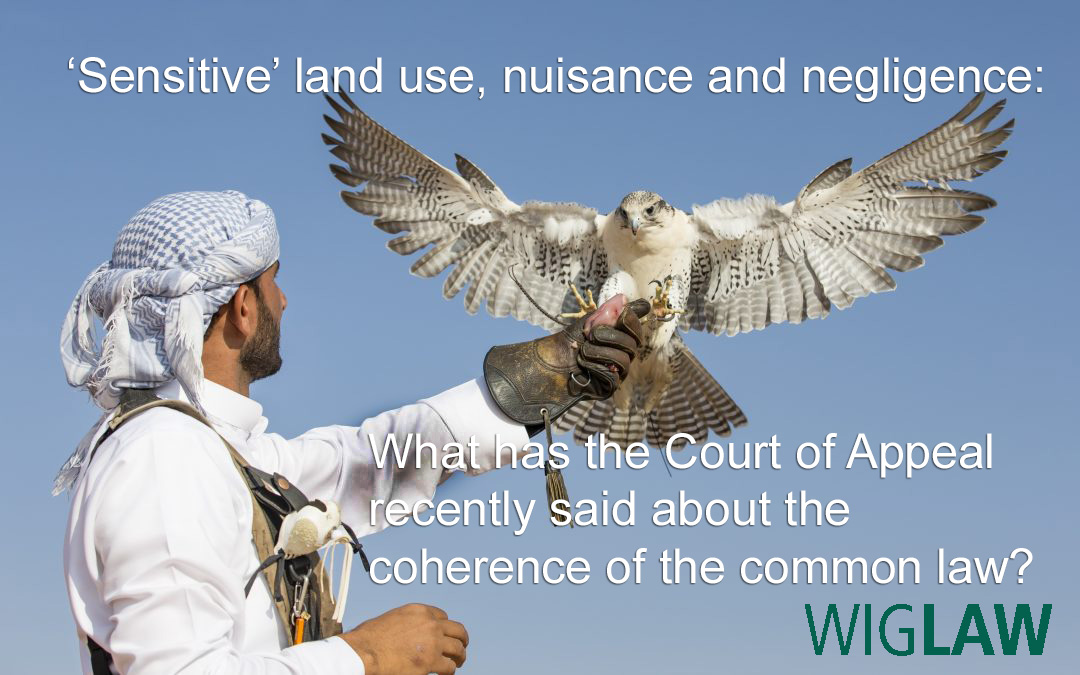
What are the circumstances in which a defendant can resist liability in nuisance on the basis that the claimant is engaged in a particular delicate or sensitive trade? Conversely, can a claimant establish liability on the ground that its unusual activity is in a “suitable” location?
These are the narrow, but important, issues decided by the Court of Appeal in Thomas v. Nicholas [2026] EWCA Civ 847.
The judgments have a wider significance because they provide useful summaries of the main aspects of the contentious majority judgment of the Supreme Court in Fearn v. Tate Gallery [2024] AC 1. These need to be understood by practitioners and the case of Thomas offers a convenient summary.
The judgments are also important because they raise the wider question about coherence in the common law and the overlap between the torts of nuisance and negligence. To what extent can a duty of care be imposed on an owner of land to take care to avoid causing a specific harm to a neighbour, when the outcome is inconsistent with core principles of the law of nuisance?
The degree of uncertainty in these areas of the law, brought about by Fearn, is indicated by the remarkable differences between the judges.
Whipple LJ would have dismissed the defendant’s appeal on both nuisance and negligence. Nugee LJ allowed the appeal on the ground of nuisance, but rejected the appeal on the basis of negligence (holding that no incoherence could be identified in so doing). Moylan LJ agreed with Nugee LJ that the appeal on the ground of nuisance should be allowed, but he would also have allowed the appeal on the ground concerning negligence (a duty of care could not be imposed which was inconsistent with the core principles of nuisance).
The outcome is that the order of the court, requiring the payment of about £250,000, was undisturbed.
Some narrower points of practice can also be learnt from the litigation as a whole.
The underlying facts were unusual, as always with nuisance cases concerning sensitive activities (see for instance the delicate paper manufactory in Robinson v. Kilvert (1889) 41 Ch D 88, underwater cabling system in E&S African Telegraph Co Ltd v. Cape Town Tramways Co Ltd [1902] AC 381, the Dr Who scriptwriter author in Emms v. Polya [1973] EGC 906 and the recording studio in Network Rail v. Morris (t/a Soundstar Studio) [2004] Env LR 41.
In this claim, the claimant started a business breeding gyre falcons in the westernmost tip of Cornwall. The birds are easily stressed, resulting in a failure to breed and to abandon or damage their eggs or young. The defendant was engaged in agricultural activities supplemented by scaffolding.
In a very unusual pleading, nuisance was alleged by way of separate ‘counts’ or instances. This was contrary to common practice, since an actionable nuisance tends to result from a continuous state of affairs on land. Where separate allegations are confined to specific acts on specific dates or times, then this suggests that the requisite underlying state of affairs may not exist. The claim had more of a flavour of negligence, rather than nuisance, making it equally surprising that negligence was not pleaded before nuisance as a possible alternative. There are points here for practitioners to note: if individual counts are necessary, is this really a claim in nuisance, and is nuisance the best argument?
The successful counts relied on a trial concerned the operation of a crane said to have amounted to a visual threat, “excessive noise”, and the use of noisy diggers, JCB excavators and dumper trucks, the raised bucket of which also amounted to a visual threat.
The same allegations of nuisance were then said to breach a duty of care in negligence “not to cause or permit the falcons to suffer excessive noise or visual threats, in particular during the Breeding Season”.
Notably, the trial judge concluded that the location of the aviaries constituted a “suitable” place for the breeding of falcons, with a result that the claimant satisfied the requirement laid down in Fearn that in order to succeed in nuisance, the claimant must be able to demonstrate that it is making a “common and ordinary” use of land given the location.
As to the negligence claim, the judge applied Caparo v. Dickman [1990] AC 605 and Robinson v. Chief Constable of West Yorkshire [2018] UKSC 4, [2018] AC 756. Applying the law incrementally, it was fair, just and reasonable to recognise the existence of a duty of care.
The grounds of appeal in respect of the findings in nuisance were that the judge had invented a novel principle of “suitable location”, that he had not applied the principle that “a man cannot increase the liabilities of his neighbour by applying his property to special uses” and that the effect of the judgment was to place an unjustifiable restraint on the defendant’s use of its land. The fourth ground was that there was no room for a negligence claim once the nuisance claim had failed.
All of which brings us to Fearn, in which the minority decision of Lord Sales JSC (and of Lord Kitchin JSC) strongly warned that the majority decision would remove the flexibility required by the tort and constitute a major change in the law: private nuisance has always been determined according to an objective reasonableness test informed by the basic principle of give and take (reasonable user).
The new approach designed by Lord Leggatt JSC in Fearn is not altogether easy to determine from his judgment, but it is usefully summarised by Nugee LJ, and practitioners are well advised to be able to locate the relevant passage (paras.107-109). The objections of Lord Sales JSC are already buried.
In summarising the primary requirements of Fearn, Nugee LJ noted that “there are two aspects to the question of liability. The first requires one to look at the impact on the claimant’s land. … An interference is only unlawful if it crosses a minimum threshold. The actual test consists of two limbs: the interference must be substantial and it must interfere with the ordinary use of the claimant’s land. … The second aspect of the question of liability looks not at the impact on the claimant’s land but on the nature of the defendant’s activity. … the defendant is not liable if his activity is itself no more than the ordinary use of the defendant’s own land and is “conveniently done”, that is to say, done with proper consideration for interests of neighbouring occupiers.”.
Nugee LJ did not have much hesitation in considering the breeding of gyre falcons to be a sensitive trade. More importantly, the judge’s conclusion that the claimant’s use of land was a common or ordinary one, was only supported by his conclusion that this particular locality in Cornwall was a suitable one. In the cases mentioned above, Robinson v. Kilvert and Cape Town, the particular activities were done in entirely suitable places, but this did not make them “common or ordinary”.
Secondly, the question whether there is an interference with a common and ordinary use of land must be an objective one, and one which is part of a minimum threshold test. The judge examined his question by reference to the conduct of the defendant. Leaving the bucket of a digger in the air would not be a threat to other agricultural uses in the area, and excessive noise was not shown to have constituted an interference with other uses of the land. Locality is an important part of this test.
All in all, “A man cannot increase the liabilities of his neighbour by applying his own property to special uses”, as it was said in Cape Town.
These are general principles which can be applied in instances of sensitive trades. That does not mean, however, that a sensitive claimant can never succeed. The scriptwriter in Emms v. Polya succeeded because although he was neurotic, the noise he experienced during building renovations next door would have annoyed anyone and because the works were not done with due consideration for his interests.
For the judges who decided that the claim in negligence was out, it was important that the defendant knew that the activities it carried out during the breeding season were likely to cause harm to the falcons, and, these activities could have been done differently and outside the breeding season.
As Nugee LJ put it: “It would be wrong (and cause a lack of coherence in the law) for a duty of care to be imposed on the occupier of land if the practical effect would be to prevent him from carrying out some ordinary activity on the land at all. But that does not mean he is entitled to immunity for some activity if he is carrying it out in a particular way that is foreseeably harmful to his neighbour where there is another way of carrying it out that would be equally available for his purposes and less injurious to his neighbour.”
The judges commented variously on the extent to which nuisance law has assimilated principles relevant to negligence. Moylan LJ accepted the defendant’s submission that the judge had created a duty of care inconsistent with the law of nuisance, which would undermine the “bespoke” tort of nuisance and be incoherent. Only the Supreme Court can resolve this issue.
Would ‘successful’ be clearer here?